Ever sat across from your partner and felt like you were speaking two different languages? If so, you are far from alone. Most couples hit a rough patch at some point, and many wait too long to ask for help.
At Heart Connection Center, we meet couples from all over Boca Raton. Some live near Mizner Park, and others are close to Florida Atlantic University. Most share one worry. They want help, but they are not sure how to pick a couple therapist who are truly a good fit.
This guide walks you through the process. You will learn the signs it is time to call, which questions to ask, and which red flags to avoid. We also cover in-person, online, and intensive options so you can choose what suits your life.
Why the Right Couple Therapist Matters So Much
Couples counseling works for many people. According to the American Association for Marriage and Family Therapy, over three-fourths of people who get couples or family therapy report a better couple relationship. That is a strong result.
Still, those numbers do not mean every therapist will click with every pair. Fit matters as much as the method. If one of you feels judged or ignored, progress stalls fast.
Timing matters too. Research suggests the average couple waits about six years after problems begin before getting help. That is a long time to live with the same sore spots. The sooner you talk with a couple of therapists, the less ground you have to win back.
Signs It May Be Time to Call a Couple Therapist
You do not need a crisis to book a first visit. Many couples call us when things feel off but not broken.
Here are common signs:
- You have the same argument again and again with no fix
- You feel more like roommates than partners.
- One of you shuts down or leaves the room during hard talks.
- Trust has taken a hit after a secret, a betrayal, or a broken promise.
- A big change, like a new baby, a move, or a job loss, has thrown you off.
- Intimacy has faded, and neither of you knows how to bring it up.
If two or more of these sound familiar, it is a good time to talk with a professional. If your partner is unsure, that is okay. Many people feel nervous at first.
How to Find a Couple Therapist in Boca Raton, FL
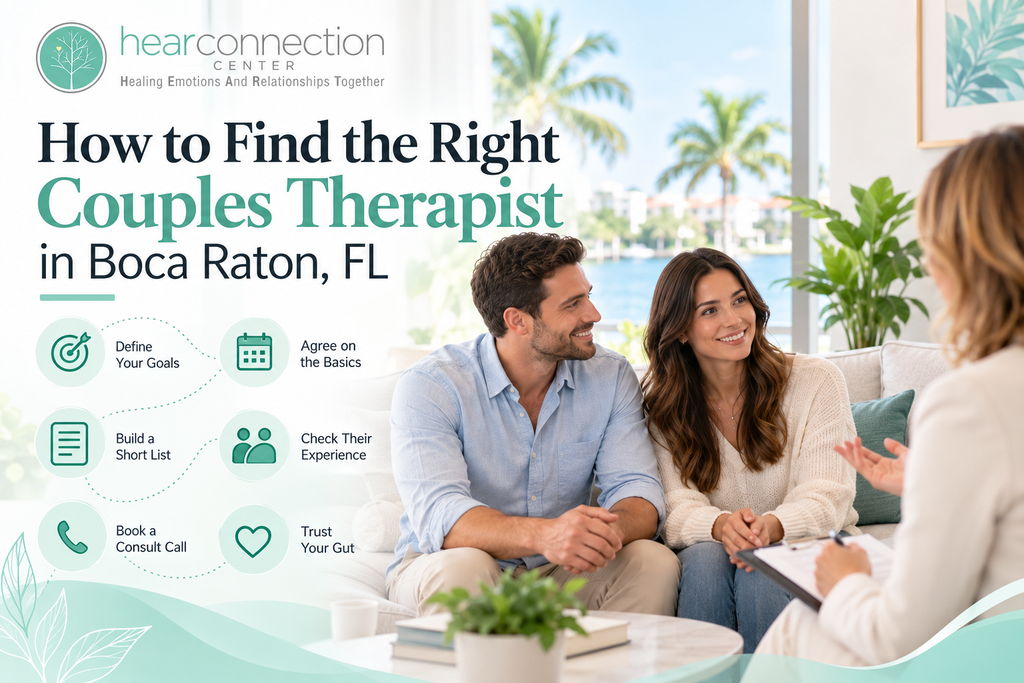
Searching online can bring up hundreds of names. Here is a simple plan to narrow the list.
- Write down your goals. Do you want better communication, help after broken trust, or a plan for a big decision? Clear goals make it easier to spot the right fit.
- Agree on the basics together. Talk about the budget, the schedule, and whether you prefer in-person or online visits. Doing this early saves frustration later.
- Build a short list. Check therapist directories, ask your doctor, and read practice websites. Aim for three names.
- Check their experience with couples. Look for a couple therapist who works with couples every day, not just occasionally.
- Book a short consult call. Most practices offer one. Notice how the therapist speaks to both of you.
- Trust your gut after session one or two. You should feel safe, heard, and gently challenged.
The best couple therapist is the one both partners feel comfortable with, not the one with the flashiest website.
Questions to Ask Therapists for Couples on a First Call
A short call can tell you a lot. Try these questions:
- How much of your work is with couples?
- What approach do you use, such as the Gottman Method or Emotionally Focused Therapy?
- How do you keep sessions fair when partners see things differently?
- How long does treatment usually take?
- What happens if one of us is not ready to talk yet?
- What are your fees, and do you provide superbills for insurance?
Listen for clear, plain answers. Good therapists explain their process without jargon and without promises they cannot keep.
Couples Therapy Near You: Picking a Location That Fits
Location is not a small detail. If the drive feels like a hassle, sessions get skipped. Pick an office that works with your week.
At Heart Connection Center, our Boca Raton office is located at 1489 W Palmetto Park Road, Suite 410. It sits in central Boca Raton, so couples from Mizner Park, Town Center at Boca Raton, and the neighborhoods near Florida Atlantic University can reach us easily. Couples from Deerfield Beach, Delray Beach, Boynton Beach, and Highland Beach come to see us too.
Here is a tip from us. Book a time after a calm part of your day, like a lunch break or an early evening slot. A walk at Red Reef Park afterward gives you space to talk through what came up.
Want a deeper look at what couples therapy involves? Read our guide, Couples Therapy in Boca Raton, FL: Complete Guide to Relationship Counseling.
In Person, Online, or Intensive: Which Format Fits?
Different couples need different setups. Here are the three most common.
- In person sessions. These are great if you want a calm space away from home. Our couples counseling visits take place in our Boca Raton office at 1489 W Palmetto Park Road, Suite 410.
- Online sessions. These suit busy schedules and long workdays. Our online therapy option lets you join together from home.
- Intensive sessions. These are longer, focused visits instead of one hour a week. Our intensive couples counseling fits couples who want to move faster.
Pick the format you will actually show up for. Steady attendance beats a perfect plan.
Red Flags to Watch for in Relationship Therapists
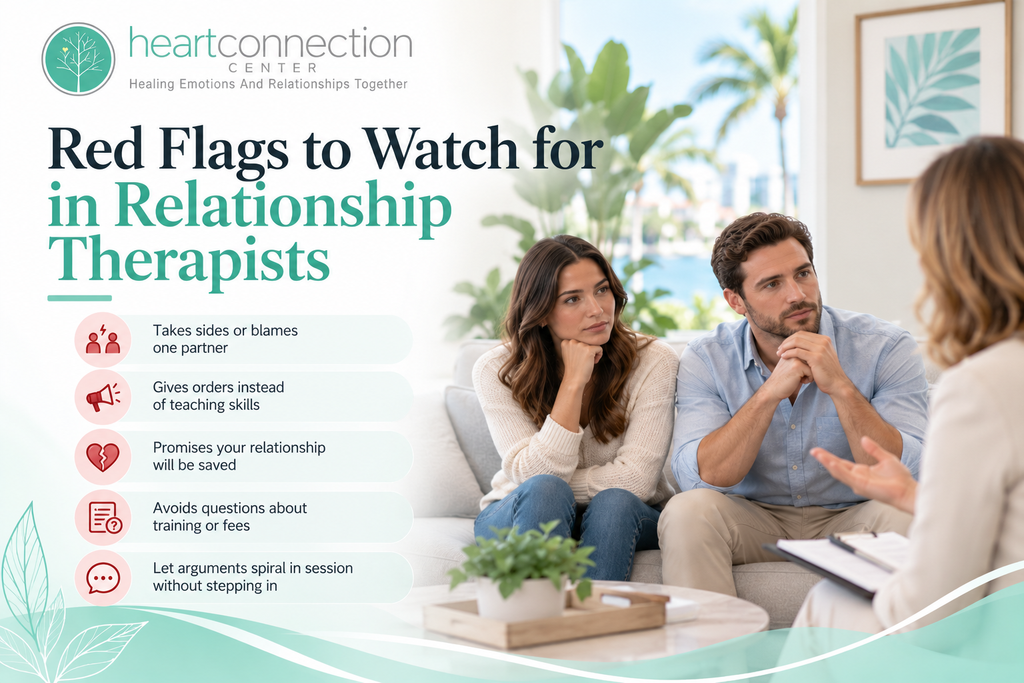
Most therapists are caring and skilled. Still, know the warning signs:
- Takes sides or blames one partner
- Gives orders instead of teaching skills
- Promises your relationship will be saved
- Avoids questions about training or fees
- Let arguments spiral in session without stepping in
If you notice any of these, it is fine to move on. You are hiring a guide, not a judge.
What to Expect in Your First Few Sessions
First sessions are mostly about listening. Your couple therapist will ask about your history, what brought you in, and what you hope will change. Each of you gets to share your side. Nobody gets a verdict.
After that, the work shifts to patterns. Our philosophy at Heart Connection Center is simple. The pattern is the problem, not either of you. Once you both see the loop, you can step out of it and talk in new ways.
Between visits, you may get small tasks, like a daily check-in or a calmer way to start a hard talk. Many couples notice small shifts first, such as fewer blowups or more kindness at the dinner table. Bigger changes build from there.
Take the First Step with the Heart Connection Center.
Finding the right couple therapist takes a little work, but it pays off. Set clear goals, ask good questions, and trust how you feel in the room. The first call is often the hardest part.
If you are ready, we would be glad to hear from you. Our team at Heart Connection Center will match you with a therapist who suits you both. Book an appointment today and take the first step toward feeling close again.
FAQs
How do I find a good therapist in Boca Raton, FL?
Book short consults with two or three therapists for couples. Pick the couple therapist who listens well, explains a clear plan for your goals, and feels fair to both of you.
When should couples consider relationship counseling?
Consider it when the same fight keeps returning, you feel more like roommates, trust has cracked, or a big change hits, such as a baby or a move. Gottman research says couples wait about six years, so sooner helps.
Do couple therapists in Boca Raton offer online sessions?
Yes. Many relationship therapists in Boca Raton, including our team at Heart Connection Center, offer telehealth. Online sessions suit busy partners who commute or travel often, and you can join together from home.
What should I ask a couple of therapists before the first session?
Ask about their experience with couples and their approach, such as Gottman or EFT. Also ask how they handle conflict in session, how long treatment usually lasts, and what fees or insurance options they accept.
Can couples therapy help if only one partner wants to go?
Yes, it can still help. One partner who changes how they respond can shift the whole pattern. Many couples start with one person, and the reluctant partner often joins later once they see it is not about blame.