You have had the same argument three times this month. Or maybe nobody argues anymore, and the quiet feels worse. Either way, you are searching for a couple therapist in Boca Raton and wondering where to begin.
A couple therapist is a licensed mental health professional who helps two partners understand their patterns, communicate more clearly, and decide what they want for the relationship. To choose one, confirm the license, ask about training in couples work, make sure both of you feel heard, and check that the practical details fit your lives.
This guide covers each step. It also explains what a first session may look like and when another kind of help should come first. It is written for married, engaged, dating, and long-term partners in Boca Raton and nearby communities, including people unsure whether the relationship will continue.
What Does A Couple Therapist Do?
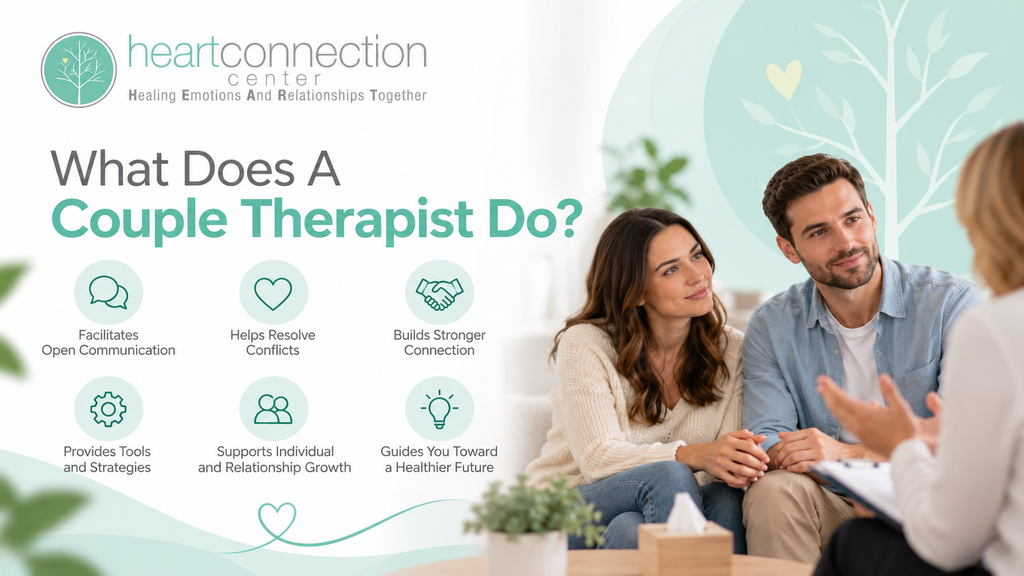
Couples therapy is talk therapy in which a trained clinician meets with both partners together. Relationship counseling means the same thing in most settings. The therapist helps you see the pattern between you and does not decide who is right.
Friends and family love you, and they often take a side. A therapist has training in how relationships work and stays neutral. Sessions may focus on:
- How the two of you talk during conflict
- Emotional closeness, or feeling like roommates
- Trust, including trust after an affair
- Intimacy and affection
- Big transitions such as a new baby, a move, retirement, or a health scare
- Shared goals about money, family, and the future
At Heart Connection Center, our founder is a Florida-licensed mental health counselor who is certified in Emotionally Focused Therapy (EFT) for couples. EFT is a structured approach that helps partners see the cycle they get caught in, such as one person pushing while the other pulls away. Then it helps them build a safer emotional bond. Other therapists use different models, so the questions below matter.
Signs You May Benefit From Relationship Counseling
You do not need a crisis to book a first appointment. Many couples start because the same problems keep returning. Common signs include:
- The same argument repeats with no resolution
- One or both of you shut down or avoided hard topics
- You feel more like roommates than partners
- Secrets, an affair, or broken promises have damaged trust
- A major change has put strain on you both
- You disagree about staying together and want help thinking it through
Every couple argues. One disagreement does not mean something is wrong with you. A therapist can help you tell a rough week from a lasting pattern.
How To Choose The Right Couple Therapist In Boca Raton
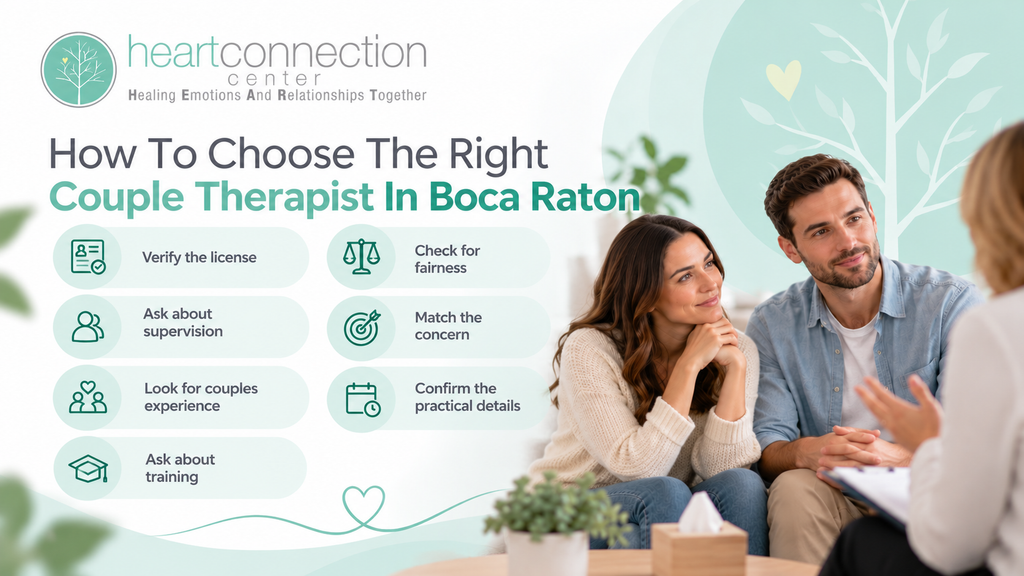
Begin with the license, then look at the couple’s experience, then fit. Use this checklist:
- Verify the license. In Florida, therapists for couples include licensed mental health counselors (LMHC), licensed marriage and family therapists (LMFT), licensed clinical social workers (LCSW), and licensed psychologists. Their education, supervised hours, and scope of practice differ, so the credentials are not interchangeable. The state board’s license lookup covers counselors, marriage and family therapists, and clinical social workers. Psychologists are licensed through a separate board.
- Ask about supervision. Some clinicians are registered interns who work under a supervisor. That is allowed, but you should know before you book.
- Look for couples experience. Helping two people who see one problem differently is its own skill. Ask how much of the caseload is couples.
- Ask about training. Titles like relationship coach or marriage coach often do not require a mental health license. Ask which approach the therapist uses, such as EFT, the Gottman Method, or behavioral couple therapy, and what training they completed.
- Check for fairness. You should both feel heard. If one partner feels outnumbered after a few sessions, say so.
- Match the concern. If sexual concerns are the main issue, ask about specific training in sex therapy.
- Confirm the practical details. Cover fees, insurance, session length, hours, and whether sessions are in person or online.
Before you book, consider asking these questions:
- What share of your clients are couples?
- Which approach do you use, and how were you trained in it?
- What happens when partners see a problem differently?
- How will we set goals, and how often will we review them?
- How do you handle information shared in an individual session?
- What do sessions cost, and what are your cancellation terms?
Be cautious with anyone who guarantees an outcome or declines to explain their approach.
What To Expect During The First Session
Procedures vary by therapist and practice. A first session often covers what brought you in, how each partner sees the problem, your history as a couple, and what you hope will change. The therapist should also explain confidentiality and its limits.
At Heart Connection Center, we discuss your goals in the first session, and we support the path you choose until you decide to change it. Many people fear a therapist will call the relationship hopeless. A good therapist helps you clarify your own goals and does not tell you what to do.
To prepare:
- Write down your top two or three concerns
- Decide what a good result would look like in six months
- Agree to describe problems without blame
- Find a private space and a quiet time, especially for online sessions
Nerves before a first session are normal.
Couples Therapy Versus Marriage Counseling
The two terms usually describe the same service. Providers pick one for habit, training, or marketing reasons. The label tells you less than the clinician’s license and training do.
| Term | How providers often use it | What to confirm |
| Couples therapy | Sessions for partners of any marital status, often tied to a named approach | License and training in couples work |
| Marriage counseling | Sessions for married partners, though many providers also see unmarried couples | Whether they see unmarried partners, if that applies to you |
| Relationship counseling | A broad term covering dating, engaged, and long term partners | Which approach they use |
How To Judge Progress And What Therapy Cannot Promise
Progress rarely moves in a straight line. A good week may be followed by a hard one. Useful signs include talking about hard subjects with less blame and recovering faster after a fight.
A 2012 review in the Journal of Marital and Family Therapy summarized a decade of studies. It reported that couple therapy helped about 70% of couples who received it. Results were similar to individual therapy and far better than no treatment. That figure is an average across many studies of couples who sought help. It cannot predict what will happen for you, and it does not mean every couple stayed together.
Therapy tends to work best when both partners attend, practice new skills between sessions, and review goals every few sessions. Ask your therapist how they track progress. No one can promise a number of sessions or a result. Some couples grow closer. Others decide, with more clarity, to part. Either result can reflect honest work.
Individual Counseling Versus Couples Counseling
In couples counseling, the relationship is the focus. In individual counseling, you are. Individual counseling may fit better if your main concerns are your own anxiety, depression, grief, or trauma, or patterns that follow you from one relationship to the next. Many people benefit from both, sometimes with different therapists.
If your partner will not attend, you can still go on your own. Our practice welcomes people in that situation. Results vary, but changing your own part of a pattern can shift how the two of you interact.
Finding Counseling In Boca Raton
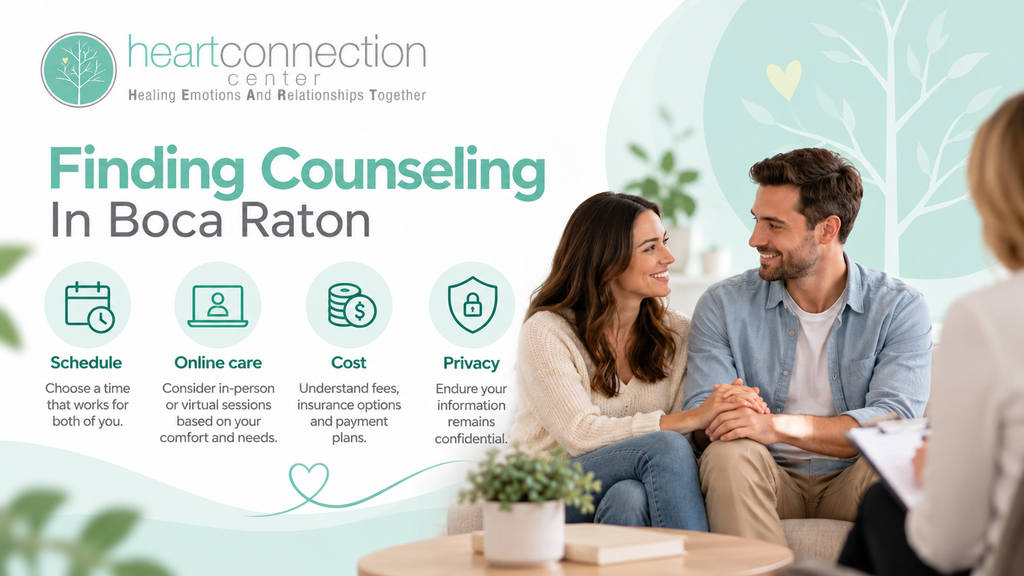
If you type couples therapy near me or counseling for marriage near me into a search bar, you will see directories, large groups, and solo practices. Decide what you need first, then compare options on these points:
- Schedule: Weekly sessions are easier to keep when both partners can reach the office or log in from work.
- Online care: Confirm the therapist is licensed where you are during the session. If you split the year between Florida and another state, ask before booking.
- Cost: Ask about fees, insurance, and whether the therapist provides a statement for out-of-network reimbursement.
- Privacy: Ask how records are kept and where confidentiality ends.
Heart Connection Center offers couples counseling in person at our Boca Raton office and online therapy for clients located in Florida. We do not participate in networks with insurance companies. Clients pay at each session, and we can provide a statement for those who want to seek out-network reimbursement. We cannot guarantee that an insurer will pay.
Joint sessions are not always the right first step. If you feel afraid of your partner, are being controlled or threatened, or have been hurt, individual support and a safety plan should come first. Joint sessions can raise risk when one partner controls the other. The National Domestic Violence Hotline offers free, confidential support at 1.800.799.7233, or you can text START to 88788. If you are in immediate danger, call 911. If you are thinking about harming yourself, call or text 988.
Taking The Next Step
The right couple therapist is licensed, trained in couples work, fair to both partners, clear about goals, and practical for your schedule. The questions above let you test each point.
If you would like to talk with us, call 561.203.9280 or use our booking page to arrange a consultation. Bring your questions. We will answer them plainly, and you can decide whether we are the right fit for you and your partner.
This guide is general education and does not replace personal clinical advice.
Frequently Asked Questions
How do I find a good therapist in Boca Raton, FL?
Start by verifying a clinician’s Florida license, then ask about training and experience with couples. Book a consultation to see whether you both feel comfortable. Fit, clear goals, and practical logistics matter as much as credentials.
Can couples counseling help save a relationship?
Couples counseling can help many couples rebuild connection, but no therapist can guarantee a relationship will last. Outcomes depend on both partners’ commitment, the issues involved, and the fit with the therapist. Some couples decide to separate with greater clarity.
What is the difference between couples therapy and marriage counseling?
There is usually no practical difference, because providers use both terms for the same service. Marriage counseling often refers to married partners, while couples therapy is broader. Check the clinician’s license and couples training instead of the label.
When should couples consider relationship counseling?
Consider counseling when the same conflicts repeat, communication has broken down, trust has been damaged, or a life change strains you both. You do not need to wait for a crisis, and many couples start while they still feel hopeful.
How do I know if I need individual counseling?
Consider individual counseling if your main struggles involve your own anxiety, depression, grief, trauma, or patterns that repeat across relationships. You can also start alone if your partner declines couples sessions. A therapist can help you choose.